
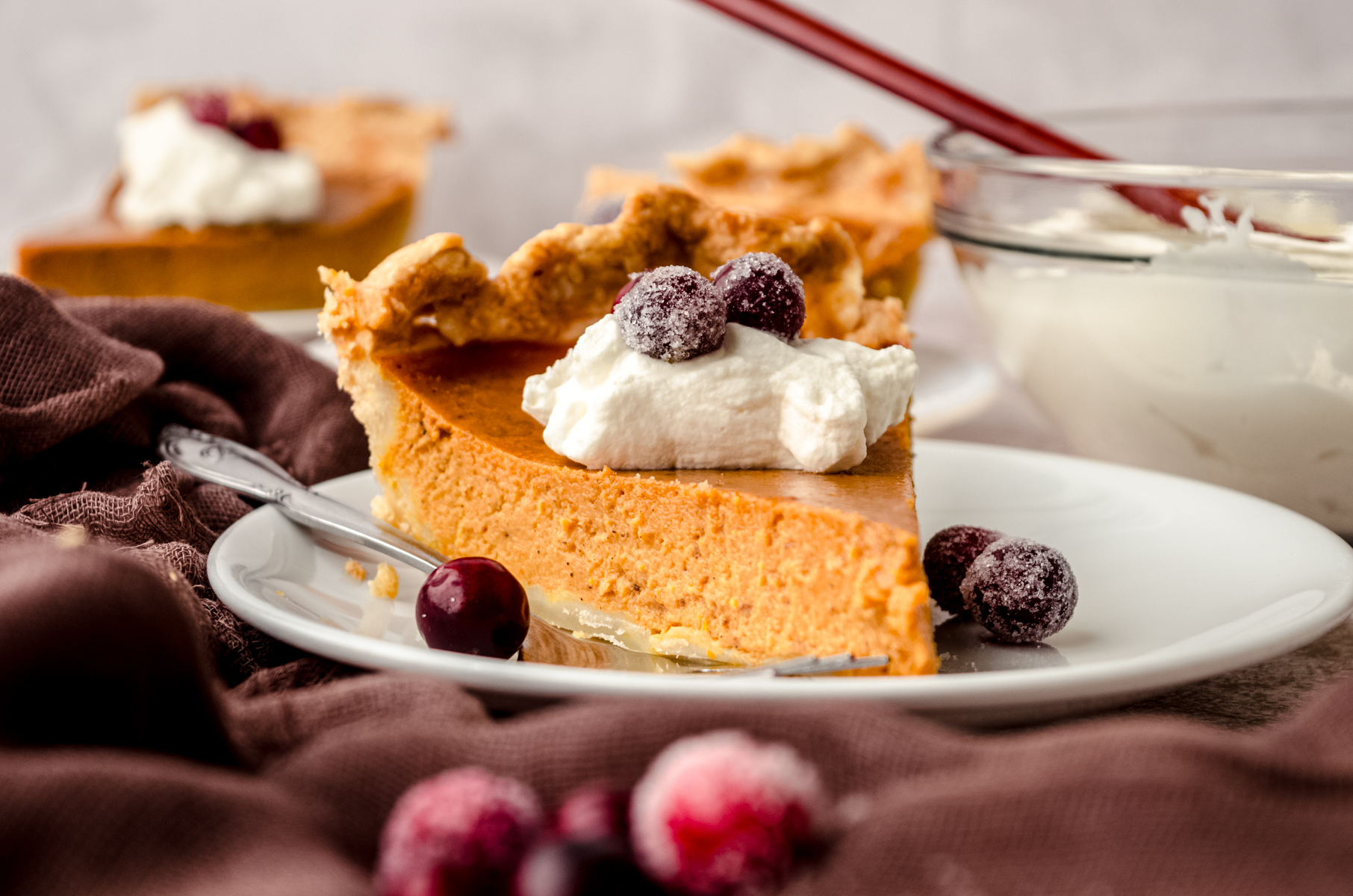
In my old bakery days, pumpkin pie was the quiet workhorse of the holiday case. Not flashy, not fussy, but it had to be right: smooth custard, warm spice, and a crust that stayed crisp at the edge and fully baked underneath. At home, I want the same thing, just with fewer chances to overthink it.
This recipe is built for the way real kitchens work. We use pumpkin puree (not pre-sweetened filling), a simple spice blend that tastes like pumpkin instead of perfume, and one key move for texture: blind baking the crust so the bottom does not turn into pumpkin pudding.

You will also get the custard cues I rely on every time: how the center should wobble, where to look for set edges, and why cooling is not optional if you want slices that hold. If you have ever pulled a pie too early, baked it until it cracked, or ended up with a wet bottom, you are in the right place.
What makes it custard
Pumpkin pie is a baked custard. That means eggs provide the structure, dairy provides richness, and gentle heat turns the liquid filling into a sliceable, creamy set. The goal is fully cooked eggs without overheating the custard. When the filling gets too hot, especially if it starts bubbling at the edges, the proteins tighten up and the pie is more likely to curdle, puff, and crack.
Once you start thinking of pumpkin pie as custard, the “rules” make more sense: bake on the lower rack so the crust gets more direct heat, avoid overbaking, and cool slowly.
Puree vs pie filling
These cans look similar and they are absolutely not interchangeable.
- 100% pumpkin puree is just cooked pumpkin (often a squash variety labeled as pumpkin). It is unsweetened and unspiced, which is what you want for controlling flavor and texture.
- Pumpkin pie filling is pre-sweetened and pre-spiced. Using it in a recipe written for puree can throw off the sugar, spice, and set of the custard.
For this recipe, use pumpkin puree. If all you have is pie filling, you can still make pie, but you will need a different formula than what is written here.
Spice balance
I love pumpkin pie spice blends, but the best pumpkin pie does not taste like a candle. Cinnamon is the backbone, ginger adds brightness, cloves bring depth, and nutmeg rounds everything out. The trick is using enough spice to be cozy but not so much that it dries out your palate.
If your spices have been living in the back of a cabinet for years, do yourself a favor and replace them. Old spices do not get “subtle.” They get dusty.
Blind baking matters
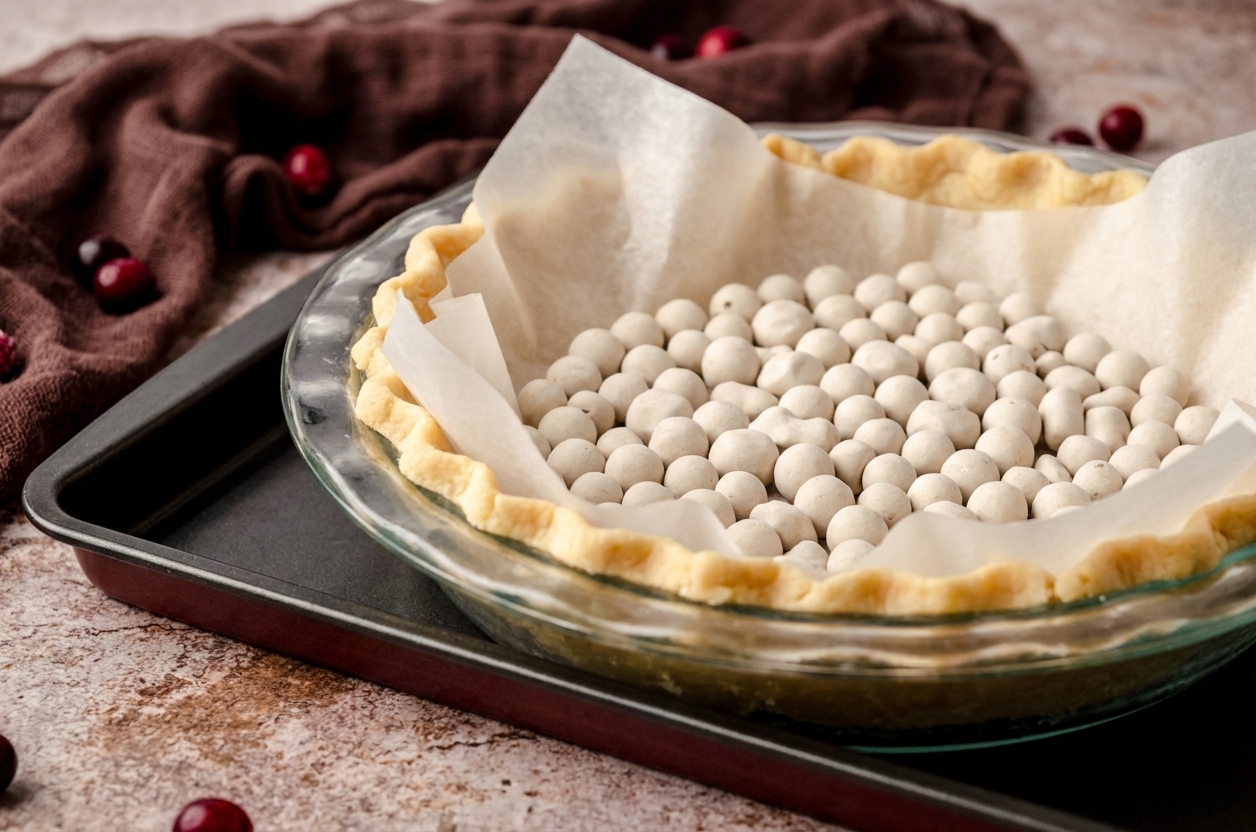
Custard pies are steamy by nature. As the filling heats, moisture and steam move through the crust. If the crust is raw when the filling goes in, the bottom can stay pale and soft. Blind baking jump-starts the crust, sets the structure, and gives you a head start on browning.
In this recipe, you will fully preheat a sheet pan, dock the chilled crust, line it, fill it with pie weights, and bake until the edges are set. Then you bake a few minutes more without weights so the base is no longer glossy. Timing varies by pan and dough, so I lean on visual cues here, but the recipe card below gives you the ranges that work in a normal home oven. That is the difference between “okay” and bakery-style.
How to prevent cracks
Cracks come from overbaking and moisture loss. Here is what helps the most:
- Do not overbake. Pull the pie when the outer ring is set but the center still has a gentle wobble.
- Bake at a moderate temperature. High heat can puff the custard, then it collapses as it cools.
- Mix gently. Whisk until smooth, but avoid whipping air into the filling. Air bubbles expand in the oven and can create a rough surface.
- Cool gradually. Let the pie cool at room temperature before refrigerating so it sets without condensation collecting on top.
And a little reassurance from someone who has baked a truly unreasonable number of pies: a crack does not mean it tastes bad. It just means you get to be extra generous with whipped cream.
Doneness cues
Forget the toothpick test. Custard does not work that way. Use these cues instead:
- Edges set, center wobbles: The outer 2 to 3 inches should look set and matte. The center should jiggle like gelatin, not slosh like liquid.
- Internal temperature (optional but precise): If you like numbers, aim for around 175 to 180°F in the center, and use the wobble test as your backup. Different pans and formulas can land a little earlier or later.
- No active bubbling: If you see the filling bubbling at the edges or puffing dramatically, you are getting close to overbaked.
The pie will continue to cook a little from residual heat after it leaves the oven. That carryover is your friend.
Cooling and slicing
Pumpkin pie needs time to set. I know, waiting is brutal when your kitchen smells like cinnamon and butter. But if you slice while it is warm, the custard has not fully firmed and you will get messy wedges.
Cool the pie completely at room temperature, then refrigerate at least a few hours (overnight is even better) before slicing. For clean slices, use a sharp knife and wipe it between cuts.
Why this recipe works
- Custard-friendly ratios: Enough eggs to set cleanly, enough dairy to stay creamy, and enough pumpkin for a full-bodied texture.
- Blind baked crust: Pre-baking prevents a soggy bottom and helps the crust stay crisp even after chilling.
- Balanced spice: Warm, classic flavor without overpowering the pumpkin.
- Clear doneness cues: You will know exactly what to look for so you do not overbake into cracks.
- Cooling guidance: The set continues as it cools, which is how you get slices that actually hold their shape.
Ingredient notes
Pumpkin puree
Use 100% pure pumpkin puree, not pumpkin pie filling. The filling is already sweetened and spiced and will throw off the set.
Brown sugar
Brown sugar deepens the flavor and nudges the pie toward that classic caramel note. Either light or dark brown sugar works.
Evaporated milk and heavy cream
Evaporated milk brings classic pumpkin pie flavor and structure, while a little heavy cream adds silkiness. This combo gives a custard that is rich but still slices cleanly.
Eggs and yolk
Whole eggs set the custard; the extra yolk adds richness and a smoother texture.
Spices
Ground cinnamon, ginger, nutmeg, and cloves give you a traditional profile. If you prefer, you can swap in pumpkin pie spice, but do not overdo it.
Pie crust
This recipe assumes a single 9-inch pie crust, homemade or store-bought. Keep it cold before blind baking so it holds its shape.
Equipment you will need
- 9-inch pie dish (glass or metal both work)
- Rimmed baking sheet (for baking the pie and catching any butter drips)
- Parchment paper or aluminum foil (for lining the crust)
- Pie weights or dried beans or rice (for blind baking)
- Mixing bowl and whisk
- Fine-mesh strainer (optional, for an extra-smooth custard)
- Instant-read thermometer (optional, for doneness confidence)
Pro tips
- Chill the shaped crust: After fitting the dough into the dish, chill it at least 20 to 30 minutes. Cold dough slumps less.
- Preheat the sheet pan: Baking the pie on a hot sheet pan helps the bottom crust set faster.
- Shield the crust edge if needed: If the rim browns too fast, loosely cover it with foil.
- Whisk gently: Mix until smooth but do not froth. Less air means a smoother top.
- Strain for bakery smoothness: If you want that ultra-silky custard, strain the filling before pouring it into the crust.
- Let it chill before slicing: Refrigeration is what gives you clean, tidy wedges.
Substitutes that work
- Spices: Swap the individual spices for pumpkin pie spice. Use 2 teaspoons total, then taste the mixture and adjust.
- Dairy: In a pinch, you can use all evaporated milk (and skip the cream) for a more traditional, slightly lighter pie. You can also use half-and-half instead of the heavy cream.
- Sugar: Granulated sugar works if needed, but you will lose some of the molasses depth that brown sugar adds.
- Crust: A store-bought refrigerated crust is fine. Treat it the same way: chill, then blind bake.
Variations
- Extra-spicy: Add an extra 1/4 teaspoon ginger and a pinch of black pepper for gentle heat.
- Maple pumpkin pie: Replace 1/4 cup of the brown sugar with maple syrup. (Keep an eye on bake time since the filling is slightly looser.)
- Gingersnap crumb crust: Use a cookie crumb crust if you prefer. Bake the crust first, then fill and bake as directed, watching the edges for over-browning.
- Boozy aroma: Add 1 to 2 teaspoons bourbon or dark rum to the filling for a warm finish.
Serving ideas
- Classic whipped cream with a pinch of cinnamon on top
- Vanilla ice cream for a warm-and-cold contrast
- Salted caramel drizzle if you like a sweeter finish
- Toasted pecans scattered over whipped cream for crunch
- Serve slightly cool, not icy cold, for the best flavor
Storage and reheating
Refrigerator
Cover and refrigerate pumpkin pie for up to 4 days. Custard pies should not sit at room temperature for extended periods.
Make-ahead
This is a great make-ahead dessert. Bake the day before, cool completely, then refrigerate overnight for the cleanest slices.
Freezing
You can freeze pumpkin pie, but the texture can become slightly more watery after thawing. If you freeze it, wrap well, thaw overnight in the refrigerator, and expect a softer custard.
Serving after chilling
For best flavor, let slices sit at room temperature for 10 to 15 minutes before serving.
Common mistakes
- Using pumpkin pie filling instead of puree: This can make the pie too sweet and change the set.
- Skipping blind baking: The bottom crust often stays underbaked and soggy.
- Overbaking: The pie looks “done” when it is puffed and fully firm, but that is usually when cracks happen.
- Slicing warm: The custard needs time to fully set, especially after refrigeration.
- Overmixing: Whipping air into the filling can cause bubbles and a rough surface.
FAQ
Why did my pumpkin pie crack?
Most commonly, it was overbaked. Custard cracks when it overheats and tightens, then contracts as it cools. Next time, pull it when the edges are set and the center still gently wobbles.
How do I know pumpkin pie is done without a thermometer?
Look for a set outer ring (2 to 3 inches) and a center that jiggles like gelatin, not like liquid. If the whole pie ripples, it needs more time. If it is fully firm, it is probably overbaked.
Do I have to refrigerate pumpkin pie?
Yes. Pumpkin pie is an egg-based custard, so it should be refrigerated once cooled.
Can I make it a day ahead?
Absolutely. Pumpkin pie is often better the next day because the custard fully sets and the spices mellow into the filling.
Why is my crust soggy?
Usually it is from not blind baking long enough, or from skipping the step where you bake briefly without weights to dry the base. Baking on a preheated sheet pan also helps.
The recipe
Classic Pumpkin Pie
A classic, custard-style pumpkin pie with a flaky crust, balanced warm spices, and a smooth, sliceable set. Includes blind baking for a crisp bottom and clear doneness cues to prevent cracks.
- Prep
- 30 minutes
- Cook
- 60 minutes
- Total
- 6 hours 30 minutes
- Yield
- 1 (9-inch) pie, about 8 slices
Ingredients
- 1 (9-inch) unbaked pie crust (homemade or store-bought), fitted into a 9-inch pie dish
- 1 large egg, beaten (for egg wash, optional)
- 1 (15-ounce) can 100% pumpkin puree
- 3/4 cup packed brown sugar (light or dark)
- 1/2 teaspoon fine salt
- 1 1/2 teaspoons ground cinnamon
- 1 teaspoon ground ginger
- 1/4 teaspoon ground nutmeg
- 1/8 teaspoon ground cloves
- 2 large eggs
- 1 large egg yolk
- 1 (12-ounce) can evaporated milk
- 1/2 cup heavy cream
- 1 teaspoon vanilla extract
- 1 teaspoon fresh lemon juice (optional, for brightness)
Instructions
- Preheat. Place a rack in the lower third of the oven. Put a rimmed baking sheet on the rack and preheat the oven to 375°F.
- Chill the crust. If you have time, chill the pie crust in the dish for 20 to 30 minutes while the oven heats. This helps prevent shrinking.
- Dock and line. Prick the bottom of the chilled crust all over with a fork. Line the crust with parchment paper or foil, pressing into the corners.
- Blind bake with weights. Fill the lined crust with pie weights (or dried beans). Set the pie dish on the preheated baking sheet and bake for 15 to 18 minutes, until the edges look set and lightly dry.
- Finish blind baking. Carefully lift out the parchment and weights. Return the crust to the oven and bake 5 to 8 minutes more, until the bottom looks matte and no longer glossy. If using the egg wash, brush the warm crust lightly with the beaten egg and bake 1 minute to set it. Reduce oven temperature to 350°F.
- Mix the filling. In a large bowl, whisk together the pumpkin puree, brown sugar, salt, cinnamon, ginger, nutmeg, and cloves until smooth. Whisk in the 2 eggs and egg yolk until fully combined. Whisk in the evaporated milk, heavy cream, vanilla, and lemon juice (if using) until smooth. For an extra-silky texture, strain the mixture through a fine-mesh strainer.
- Fill. Pour the filling into the warm, par-baked crust. Tap the pie dish gently on the counter once or twice to release any large air bubbles.
- Bake. Bake at 350°F on the lower rack (still on the baking sheet) for 40 to 55 minutes, or until the outer 2 to 3 inches are set and the center still has a gentle wobble like gelatin. If using a thermometer, the center should read around 175 to 180°F. If the crust edge browns too quickly, loosely cover it with foil during the last 15 to 20 minutes.
- Cool completely. Transfer the pie to a wire rack and cool at room temperature until completely cool, about 2 to 3 hours.
- Chill to set. Cover and refrigerate at least 4 hours (overnight is best) before slicing for clean wedges.
- Slice and serve. Slice with a sharp knife, wiping the blade between cuts. Serve chilled or let slices sit at room temperature for 10 to 15 minutes for the fullest flavor.
Notes
- Pumpkin puree vs pie filling: Use 100% pumpkin puree here. Pumpkin pie filling is pre-sweetened and pre-spiced and will not behave the same in this formula.
- Doneness tip: It is better to pull the pie when the center still wobbles than to bake until completely firm. The custard continues setting as it cools.
- Storage: Refrigerate leftovers, covered, for up to 4 days.