
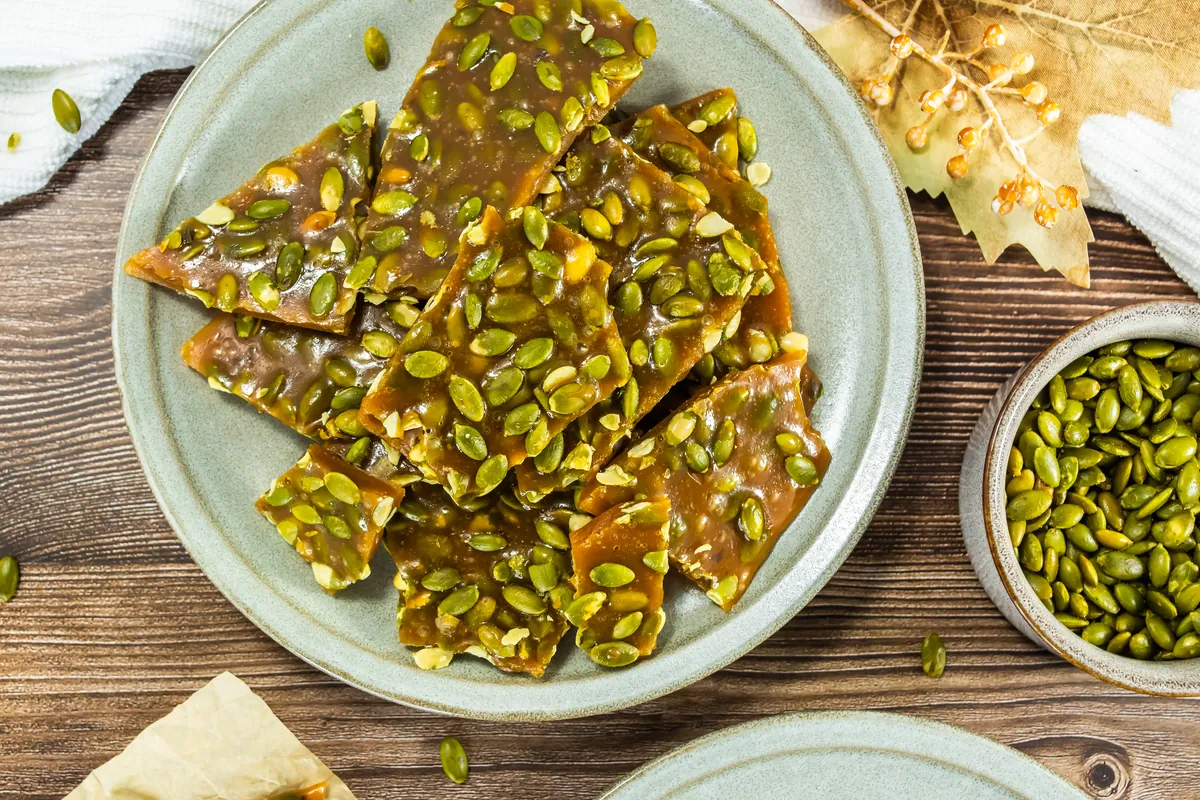
I love roasted pumpkin seeds for their toasty, snacky crunch, but brittle is a different kind of magic. Instead of a dry roast in the oven, you build a sugar syrup on the stove, take it all the way to hard crack stage (right around 300°F), then pour it thin so it cools into a glassy sheet you can break with your hands.
This is also not the same as individually candied pumpkin seeds. With candied seeds, you are coating each seed in a thin shell, which stays nibble-friendly and a little sandy or crunchy around the edges. Brittle is one continuous candy “pane” with seeds suspended inside it, so every bite is a shatter, then a buttery caramel melt, then the nutty snap of pepitas.
One quick clarification before you start: when I say pepitas here, I mean hulled pumpkin seeds (the green ones), not the in-shell seeds you scoop from a pumpkin.

If you have ever felt intimidated by candy temperatures, I am right there with you. Here is the reassurance: you are not guessing. A thermometer tells you when you are done, and once you hit the right temperature, the rest is simply moving quickly and letting the brittle cool completely. That is when it turns from sticky to snappy.
A small safety note, because hot sugar is no joke: keep your tools close, pour carefully, and avoid touching the syrup. It is molten until it is not.
What to expect
Texture: Shatter-crisp, like thin caramel glass, with a clean snap when you break it.
Flavor: Deep caramel with roasted, slightly grassy pepita flavor and a little salt to keep it from tasting one-note sweet.
Skill level: Very doable, but you will want everything measured and ready before you turn on the heat.
Equipment: A candy thermometer, a heavy-bottomed saucepan, and parchment paper or a silicone mat make this feel calm and controlled.
Why this recipe works
- Hard crack stage equals snap. Cooking the syrup to 300°F (hard crack stage) drives off enough water for the brittle to set into a glassy sheet instead of a sticky chew.
- Seeds go in at the end. Stirring pumpkin seeds in after the syrup hits temperature prevents overbrowning and keeps the sugar from cooling down too early.
- A thin pour cools fast and breaks cleanly. Spreading the hot brittle quickly into a thin layer gives you that classic shatter and makes it easy to snap into shards.
- Baking soda creates lighter structure. A small amount of baking soda foams the caramel slightly, making the brittle easier to bite and less tooth-sticking.
Ingredient notes
Pumpkin seeds (pepitas)
Use raw, shelled pumpkin seeds (pepitas) for the cleanest crunch. If you only have roasted pepitas, you can still use them. Just keep the heat gentle once you add them, since they can darken quickly in hot caramel.
Granulated sugar
This is the backbone of the brittle. Avoid swapping in brown sugar for the whole amount because the extra moisture and molasses can push the texture toward chewy.
Light corn syrup (optional but helpful)
A little corn syrup helps reduce crystallization, which means a smoother brittle. You can make brittle without it if you are careful about not stirring once the sugar dissolves.
Butter
Butter adds flavor and a slightly more tender bite. Use unsalted so you can control the salt level.
Baking soda
Whisk it with a pinch of salt ahead of time. You will add it quickly at the end, and the mixture will foam up immediately.
Salt
A modest amount makes the caramel taste richer and brings out the pepitas. Flaky salt on top is optional but lovely.
Equipment you will need
- Candy thermometer (clip-on or instant-read): crack stage accuracy matters here.
- Heavy-bottomed saucepan (2 to 3 quart): steady heat helps prevent scorching.
- Silicone spatula or wooden spoon: for stirring in butter, seeds, and baking soda.
- Rimmed baking sheet lined with parchment or a silicone mat.
- Offset spatula (optional): to quickly spread the brittle thin.
Pro tips
- Prep first, cook second. Measure everything and line your pan before you start. Once the syrup nears 300°F, it moves fast.
- Watch the thermometer and the color. At 300°F, the caramel should be a deep golden amber. If it is getting very dark before 300°F, your stove may run hot, so lower the heat slightly.
- Add seeds right after you hit 300°F. Remove the pan from heat, then immediately stir in the butter and seeds. This keeps the temperature from climbing and prevents bitter caramel.
- Stir in baking soda off heat. It will foam. That is normal. Stir just until evenly mixed, then pour right away.
- Spread thin for true shards. If you leave it in a thick puddle, it will set chunkier and can skew hard on the teeth.
Substitutes that work
- No corn syrup: Replace it with the same amount of honey or golden syrup for similar anti-crystal insurance, or simply omit and be extra careful not to stir once dissolved.
- Butter substitute: Dairy-free butter works well. Coconut oil can work in a pinch but will bring coconut flavor and a slightly different snap.
- Seeds: Sunflower seeds, sesame seeds, or chopped almonds can be used in the same quantity.
- Flavoring: Vanilla extract is classic. You can also use a tiny splash of bourbon, or a pinch of cinnamon, but add extracts after you take the pan off heat.
Variations
- Spiced pumpkin seed brittle: Add cinnamon and a small pinch of cayenne with the baking soda for a warm, tingly finish.
- Chocolate-dipped shards: Once fully cool, dip one end of each shard in melted dark chocolate and let set on parchment.
- Sesame-ginger brittle: Swap in sesame seeds and add a small pinch of ground ginger. Finish with flaky salt.
- Extra-salty snack brittle: Sprinkle flaky salt over the top right after pouring, while the candy is still soft.
Serving ideas
- Serve shards with a cheese board, especially with sharp cheddar, aged gouda, or creamy brie.
- Chop and sprinkle over vanilla ice cream, yogurt, or oatmeal for a crackly topping.
- Package in small bags or jars for gifts. Add a piece of parchment between layers to keep shards from sticking.
- Crush and use as a crunchy layer in parfaits, or as a topping for pumpkin pie slices.
Storage and reheating
Room temperature: Store brittle in an airtight container at room temperature, ideally with parchment between layers. Humidity is the enemy of snap.
Do not refrigerate: The fridge adds moisture and can make brittle sticky.
If it turns tacky: You can crisp it up by placing shards on a parchment-lined sheet in a low oven (about 250°F) for a few minutes, then cooling completely again. Keep a close eye so it does not overbrown.
Common mistakes
- Pulling too early: If you stop below hard crack stage, the brittle may bend or feel chewy. Aim for 300°F.
- Stirring too much early on: Excess stirring can encourage crystallization. Stir just until the sugar dissolves, then let it boil.
- Letting it sit in the pot: Once baking soda is in, pour immediately. Waiting even a minute can make it set too thick in the saucepan.
- Breaking too soon: Warm brittle can seem set but will still be a little pliable. Let it cool until fully hard and glossy before snapping.
- Making it on a humid day: You can, but expect a slightly stickier finish. Store extra-well sealed.
FAQ
What temperature is crack stage for brittle?
Hard crack stage is 300°F. That is the temperature that gives brittle its signature snap.
When do you add pumpkin seeds to brittle?
Add them after the syrup reaches 300°F, with the pan off heat. Stir them in quickly so they are evenly distributed, then proceed with the baking soda and pour.
How do I know when brittle is cool enough to break?
It should feel completely hard, not warm, and it should look glossy and set. Depending on how thin you spread it, this usually takes about 20 to 30 minutes at room temperature.
Why is my brittle sticky instead of snappy?
The most common reasons are undercooking (not reaching 300°F) or moisture exposure (humidity, a not-quite-airtight container, or refrigeration).
Is pumpkin seed brittle the same as candied pumpkin seeds?
No. Candied pumpkin seeds are individually coated, so they stay like separate crunchy bites. Brittle is a single sheet of hard candy with seeds suspended inside, broken into shards.
The recipe
Pumpkin Seed Brittle
A glossy, shatter-crisp pumpkin seed brittle cooked to 300°F, poured thin, and snapped into snackable shards with a buttery caramel crunch.
- Prep
- 10 minutes
- Cook
- 15 minutes
- Total
- 35 minutes
- Yield
- About 1 pound brittle
Ingredients
- 1 1/2 cups (300 g) granulated sugar
- 1/2 cup (120 ml) water
- 1/4 cup (80 g) light corn syrup
- 6 tablespoons (85 g) unsalted butter, cut into pieces
- 1 1/2 cups (180 g) raw shelled pumpkin seeds (pepitas)
- 1 teaspoon vanilla extract
- 1 teaspoon baking soda
- 3/4 teaspoon fine sea salt, plus flaky salt for finishing (optional)
Instructions
- Prepare a rimmed baking sheet by lining it with parchment paper or a silicone baking mat. Set it next to the stove. In a small bowl, mix the baking soda and fine sea salt so they are ready to add quickly.
- In a heavy-bottomed saucepan (2 to 3 quart), combine the sugar, water, and corn syrup. Set a candy thermometer on the pot so the tip is submerged but not touching the bottom.
- Cook over medium heat, stirring gently just until the sugar dissolves and the mixture looks clear, about 2 to 3 minutes. Once dissolved, stop stirring.
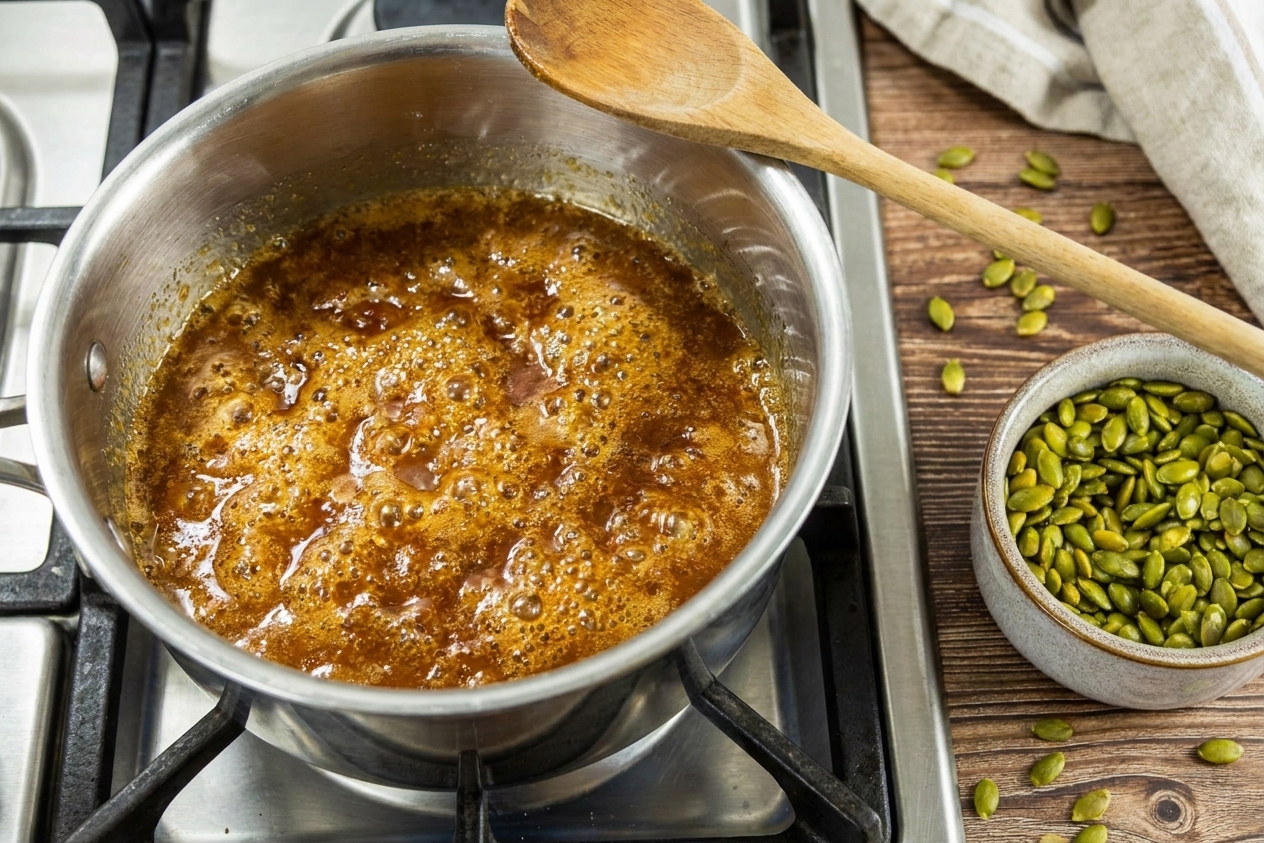
- Continue cooking, swirling the pan occasionally if needed, until the syrup reaches 300°F (hard crack stage) and turns deep golden amber, about 8 to 12 minutes.
- Remove the saucepan from the heat. Immediately stir in the butter until melted and smooth. Then stir in the pumpkin seeds until evenly coated.
- Stir in the vanilla extract, then quickly add the baking soda and salt mixture. Stir just until the brittle foams and the baking soda is fully incorporated, about 10 to 15 seconds.
- Immediately pour the foamy brittle onto the prepared baking sheet. Use a heatproof spatula or an offset spatula to spread it into a thin, even layer. Work quickly, as it sets fast.
- If using flaky salt, sprinkle it over the top while the brittle is still hot and tacky.
- Let the brittle cool completely at room temperature until hard and glossy, about 20 to 30 minutes. Once fully set, lift it off the parchment and break into shards.
Notes
Temperature is the whole game: For true brittle snap, cook to 300°F (hard crack stage). If you stop early, you will get a chewy caramel-like candy instead of shards.
Seed timing: Add the pumpkin seeds after the syrup hits 300°F and you have removed the pan from heat. This keeps the seeds from scorching and prevents the syrup from overshooting temperature.
Cooling: Let it cool completely before breaking. If it is even slightly warm, it may bend instead of snap.