
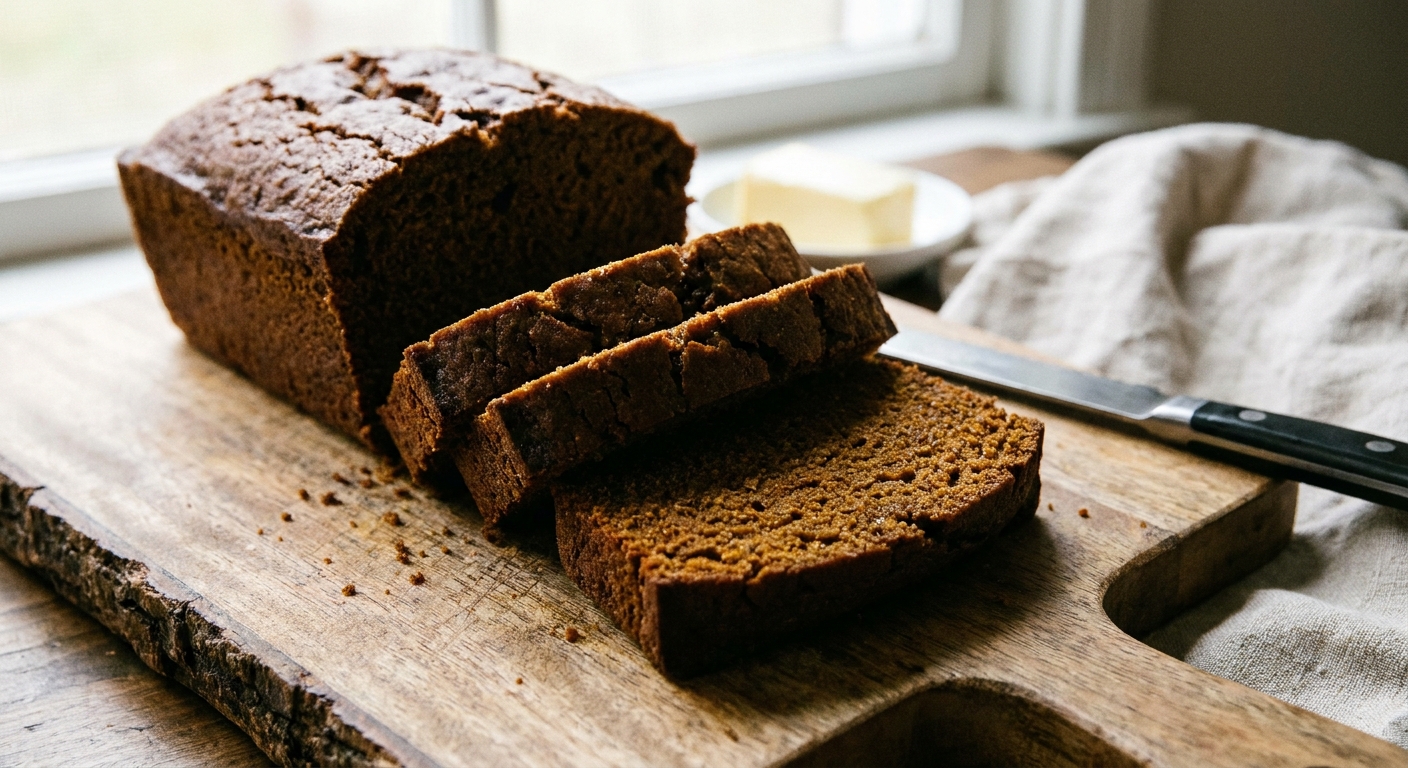
Every December at my old bakery, gingerbread was the scent that told us we were officially in the holiday rush. Not the polite, barely spiced kind, either. I mean the kind that hits you with ginger first, then leaves this warm, toasty molasses sweetness behind. This loaf is my home kitchen version: one bowl for dry, one bowl for wet, then a quick whisk and fold. No fancy mixer needed, and the crumb stays tender for a few days.

It is a quick bread, which means we are relying on chemical leaveners for lift. That is great for weeknights and last minute baking, but it also means technique matters if you want a domed top instead of a sad crater. I’ll walk you through the molasses choice (yes, it matters, and no, not blackstrap), the mixing order, and the doneness test that works best for a loaf pan where the center always lies to you.
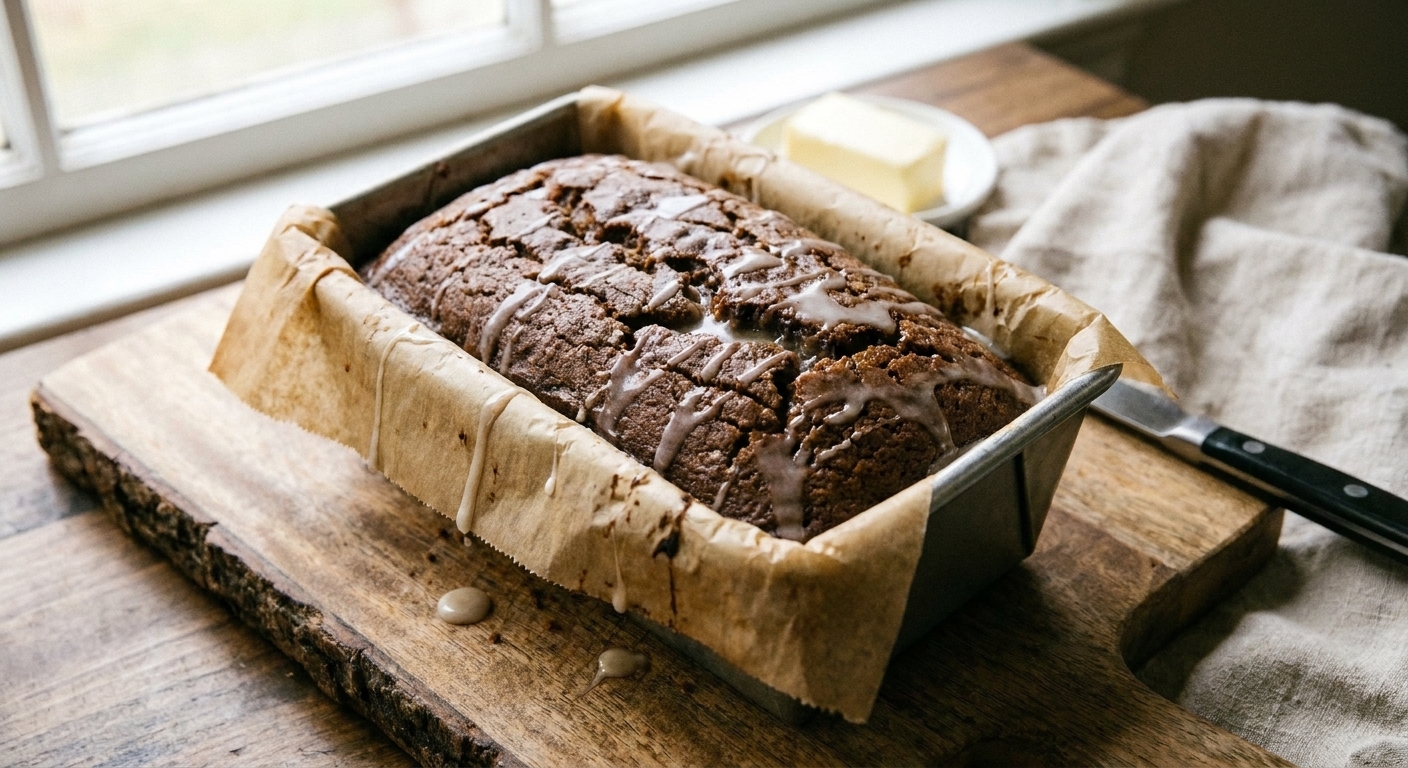
Finish it however you like: a thin vanilla glaze that soaks into the top, or my lazy favorite, a crackly ginger sugar sprinkle. Either way, this loaf is made for coffee, tea, and a second slice you pretend is “just to even it out.”
Why this recipe works
- Robust flavor without bitterness: Using unsulphured dark molasses gives you deep gingerbread character without the harsh edge that can come from blackstrap.
- Strong ginger spice that tastes clear, not dusty: A mix of ground ginger plus fresh grated ginger (optional but wonderful) brings both warmth and brightness.
- Tender crumb, not gummy: Oil keeps the loaf soft for days, while a measured amount of flour and gentle mixing prevent toughness.
- No sunken center: The batter is thick enough to support itself, and the recipe leans on the right oven temperature, proper pan fill, and a clear doneness test so the middle fully sets.
Ingredient notes
Molasses: which one to use
Reach for unsulphured dark molasses, sometimes labeled “dark” or “robust.” It is stronger than “original” or “light” molasses and gives you that classic gingerbread depth.
- Avoid blackstrap molasses here. It is much more bitter and can make the loaf taste sharp and overly mineral.
- If you only have light molasses, you can use it, but the loaf will be milder. If you want to boost flavor, add a touch more ground ginger (see Pro Tips).
Spices
Ground ginger is the star. Cinnamon and cloves support it, and a small amount of black pepper makes the ginger read as “spicier” without tasting peppery.
Fat
Neutral oil keeps the crumb tender even after refrigeration. If you prefer melted butter, you can use it, but the loaf will firm up faster as it cools.
Hot water or coffee
A little hot liquid helps bloom the spices and loosens molasses so it mixes evenly. Coffee intensifies the molasses notes without making the loaf taste like coffee.
Equipment you will need
- Standard 9 x 5-inch loaf pan
- Parchment paper (for an easy lift-out)
- Two mixing bowls and a whisk
- Microplane or fine grater (if using fresh ginger)
- Instant-read thermometer (optional but very helpful for loaf-pan doneness)
Pro tips
How to avoid a sunken center
- Do not overfill the pan: Aim for the batter to come about two-thirds to three-quarters of the way up the sides. Overfilling encourages a domed top that collapses before the center sets.
- Use the right oven temperature: Bake at a moderate heat so the loaf rises steadily and sets through the middle.
- Stop mixing as soon as the flour disappears: Overmixing develops gluten and can cause tunneling and a weak structure that falls.
- Do not open the oven early: Steam and structure are still forming in the first 35 to 40 minutes. A temperature drop can trigger sinking.
Best doneness test for a loaf pan
Use a two-part check:
- Skewer test: Insert a toothpick or skewer into the center. You want a few moist crumbs, not wet batter.
- Temperature test (my bakery trick): The center should read about 200 to 205°F on an instant-read thermometer. This is the most reliable way to avoid underbaked centers in dark, molasses-heavy batters.
For a clean slice
Let the loaf cool fully before slicing. Warm gingerbread is tempting, but it compresses easily and can seem gummy even when it is properly baked.
Substitutes that work
- Dark molasses: Substitute light molasses in a pinch, but expect a lighter gingerbread flavor. Avoid blackstrap.
- Neutral oil: Melted butter works 1:1, but the loaf will be a touch less plush once cooled.
- Hot water: Hot brewed coffee or black tea both work well.
- Buttermilk: Sour cream or plain yogurt thinned with a splash of milk can stand in. If you change the acidity significantly, do not change the leaveners unless you are experienced.
- Eggs: For an egg-free version, a flax egg can work in quick breads, but the loaf may be slightly denser.
Variations
Lemon glaze gingerbread loaf
Swap the vanilla glaze for a lemon version. The citrus cuts through molasses in the best way.
Orange sugar crust
Rub orange zest into granulated sugar and sprinkle it over the batter before baking for a crackly top.
Chocolate chip gingerbread
Fold in chocolate chips for a dessert-leaning loaf. Dark chocolate is especially good with molasses.
Nutty version
Stir in toasted chopped walnuts or pecans for crunch. Toasting matters here because it keeps the nuts from tasting flat in a strongly spiced batter.
Serving ideas
- Thick slice, lightly toasted, with salted butter
- With whipped cream or yogurt and a drizzle of honey for breakfast
- Alongside coffee or chai
- Turn leftovers into a simple dessert: cube the loaf, toast in a skillet with butter, and top with ice cream
Storage and reheating
Room temperature
Store tightly wrapped at room temperature for 3 to 4 days. Molasses loaves often taste even better on day two as the spices mellow and blend.
Refrigerator
If your kitchen runs warm or you glazed it heavily, refrigerate in an airtight container for up to 1 week. Let slices come to room temperature or warm briefly before serving.
Freezer
Freeze the whole loaf or individual slices, tightly wrapped, for up to 3 months. Thaw overnight in the refrigerator or for a couple hours at room temperature.
Common mistakes
- Using blackstrap molasses: It can make the loaf taste bitter and “off.” Stick with unsulphured dark molasses for classic gingerbread flavor.
- Overmixing: This quick bread should be mixed gently. Overmixing can cause tunneling and a tough crumb.
- Underbaking the center: A loaf can look done on top and still be raw in the middle. Use the skewer test, and ideally the thermometer check.
- Slicing too soon: Cutting while warm compresses the crumb and can read as gummy. Cool completely for clean, tender slices.
FAQ
Can I make this gingerbread loaf ahead?
Yes. It holds beautifully and often tastes better after resting overnight. Bake, cool completely, then wrap tightly.
Why did my gingerbread loaf sink in the middle?
The most common causes are underbaking, overmixing, opening the oven too early, or using too much leavener. A thermometer check (200 to 205°F in the center) is the simplest fix.
Should gingerbread be moist or cakey?
A loaf-style gingerbread should be moist and tender with a fine crumb. If it is wet and heavy, it is usually underbaked or sliced too warm.
Can I use fresh ginger only?
I would not. Fresh ginger brings brightness, but ground ginger is what gives gingerbread that steady, warm spice throughout the loaf. Use both if you want a stronger ginger hit.
What is the simplest finish?
A generous sprinkle of coarse sugar or ginger sugar before baking is the easiest option. For something a little dressier, use a quick powdered sugar glaze.
The recipe
Gingerbread Loaf
A tender, boldly spiced molasses gingerbread loaf with a deep brown sugar sweetness and a simple glaze or crackly sugar top.
- Prep
- 15 minutes
- Cook
- 55 to 70 minutes
- Total
- 1 hour 20 minutes (plus cooling)
- Yield
- 1 loaf (about 10 slices)
Ingredients
- Nonstick spray or softened butter, for the pan
- 1 3/4 cups (220 g) all-purpose flour
- 1 1/2 teaspoons ground ginger
- 1 teaspoon ground cinnamon
- 1/4 teaspoon ground cloves
- 1/8 teaspoon fine salt
- 1/4 teaspoon finely ground black pepper (optional, for extra warmth)
- 1 teaspoon baking soda
- 1/2 teaspoon baking powder
- 1/2 cup (100 g) packed dark brown sugar
- 2 large eggs, room temperature
- 1/2 cup (120 ml) neutral oil (canola, avocado, or vegetable)
- 3/4 cup (180 ml) unsulphured dark molasses (not blackstrap)
- 1 teaspoon vanilla extract
- 3/4 cup (180 ml) hot water or hot brewed coffee
- 1 tablespoon finely grated fresh ginger (optional)
- Optional sugar finish: 1 to 2 tablespoons turbinado sugar or coarse sugar
- Optional vanilla glaze: 3/4 cup (90 g) powdered sugar, 1 to 2 tablespoons milk, and 1/2 teaspoon vanilla extract
Instructions
- Prep. Heat the oven to 350°F. Grease a 9 x 5-inch loaf pan and line it with a parchment sling (leave overhang for lifting).
- Mix the dry ingredients. In a medium bowl, whisk together the flour, ground ginger, cinnamon, cloves, salt, black pepper (if using), baking soda, and baking powder.
- Mix the wet ingredients. In a large bowl, whisk the brown sugar and eggs until smooth. Whisk in the oil, molasses, vanilla, and fresh ginger (if using).
- Add the hot liquid. Slowly whisk in the hot water or coffee. The batter will look glossy and loose.
- Combine gently. Add the dry ingredients to the wet and fold with a spatula just until no dry streaks remain. Stop mixing as soon as the flour disappears.
- Fill the pan. Scrape the batter into the prepared loaf pan and smooth the top. If using the sugar finish, sprinkle turbinado sugar evenly over the surface.
- Bake. Bake for 55 to 70 minutes, until the top is set and a skewer inserted in the center comes out with a few moist crumbs (not wet batter). For the most reliable doneness check, the center should read 200 to 205°F.
- Cool correctly. Cool in the pan for 15 minutes, then lift out with the parchment and cool completely on a rack before slicing.
- Glaze (optional). In a small bowl, whisk powdered sugar, 1 tablespoon milk, and vanilla until smooth. Add more milk a teaspoon at a time until it becomes a thick but pourable glaze. Drizzle over the cooled loaf and let set for 10 to 15 minutes before slicing.
Notes
- Molasses note: Use unsulphured dark molasses for classic gingerbread flavor. Blackstrap is much more bitter and is not recommended in this loaf.
- Prevent sinking: Do not overmix, avoid opening the oven early, and bake until the center is fully set. A thermometer is the easiest insurance.
- Pan size: A smaller pan can cause overflow and underbaked centers. If using an 8 1/2 x 4 1/2-inch pan, expect a taller loaf and a longer bake time.